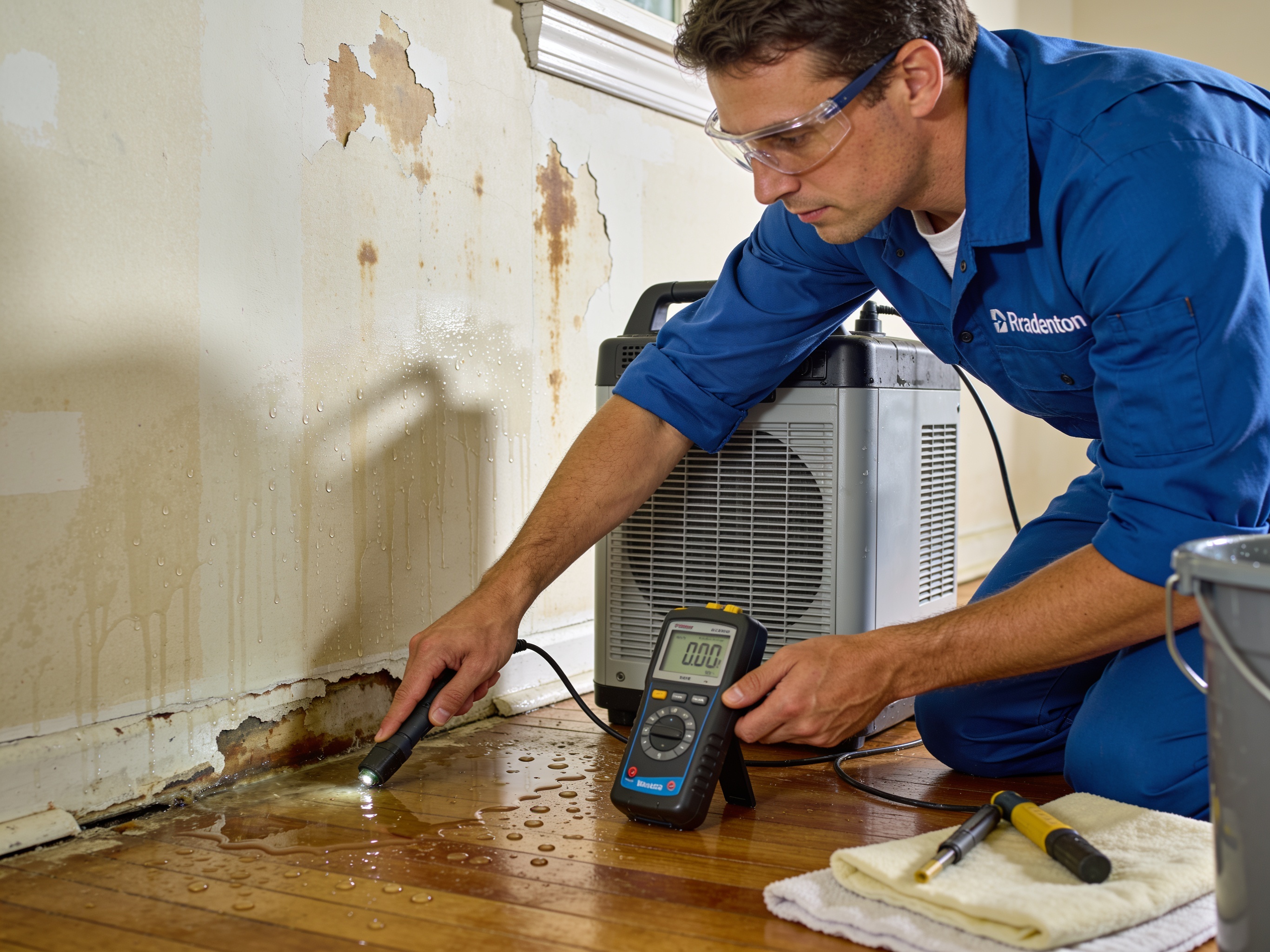
Why Bradenton Homeowners Choose Us for Water Damage Repair
We scope a repair only after the leak or entry point is found and stopped, we confirm drying before walls are closed, and we are direct about which materials can be dried and kept and which must come out. We also confirm the correct permit authority before work starts, because the parcel decides it, not the mailing address.
Repair is the last step of the job, not the first. Before anyone talks about new drywall or flooring, the source of the water has to be identified and stopped. Patching a ceiling above a supply line that is still leaking hides the problem for a while, then brings it back, usually in worse condition.
Closing a wall while it still holds moisture seals the water inside. Our crews record moisture readings as drying progresses and do not close cavities until those readings show the materials are dry enough to finish. If the readings do not reach that point, drying continues.
Some materials can be dried in place and kept. Framing and some subflooring often can. Saturated insulation, swollen particleboard and soft drywall usually must come out. We explain each decision in writing, so you can see what is being kept and why.
Permits come from the right office. Inside Bradenton city limits, permits come from the City of Bradenton Building and Permitting Division. In unincorporated Manatee County, they come from Manatee County Development Services, Building Division. A Bradenton mailing address alone does not decide which one applies. Floodplain development in Bradenton is permitted through the City's office, so a repair at a flood-prone address needs that check too.
Why Water Damage in a Bradenton Home Should Not Wait
Water left in drywall, insulation and flooring keeps those materials wet, and in Florida humidity that moisture can support mold growth and further damage. Waiting does not keep the job small. It usually makes the scope larger, because the wet area spreads and the materials underneath take on damage that was not visible at first.
Bradenton's humidity makes drying harder. When water gets into a wall, the cavity stays damp far longer than the room looks, because drywall, insulation and flooring hold moisture and release it slowly. A dehumidifier in the room dries the air, but it does not necessarily reach the moisture inside the wall.
Delay creates the mold problem. Mold needs moisture, and a wet wall that is closed up and left alone provides exactly that. Once the material is covered, the problem moves out of sight, and by the time it shows, the cleanup is larger. If mold has already started, our mold remediation service handles that work directly.
Hidden leaks keep feeding damage. A slow leak behind a finished surface can keep causing damage for an extended period, because the stain you see is only the point where the water finally showed. Floors can warp, baseboards can swell and drywall can soften while the source is still running.
Storm water does not stay where it landed. Manatee County's 2024 season, which included Hurricanes Debby, Helene and Milton in close succession, brought extreme rainfall, flooding and high winds across the county. When storm water stays in materials for a long time, the repair scope grows. Those were county-level events, and the same principle applies to any Bradenton home that took water in a storm.
Proof: How a Repair Is Scoped and Verified
A verified repair maps moisture, confirms the source has stopped and records drying readings before you receive a written scope. Each step is checked against readings.
Moisture mapping, not just the stain. The stain marks where water surfaced, not where it went. We map moisture across walls, floors and cavities beyond the visible damage, so the scope covers the real footprint.
Source confirmed stopped. Before repair, we confirm the leak, entry point or drainage problem has stopped. Repairing over an active source is unfinished work.
Drying readings documented. Readings are recorded and kept with the job file. Walls, flooring and finish wait until readings show materials are ready.
Written scope before work. A written scope lists what is dried and kept, removed, and rebuilt or refinished. Ask about any line before work starts.
Permit route for both jurisdictions. City addresses: the City of Bradenton Building and Permitting Division takes online applications, and status is checked in Accela Online Permit Search. Permits expire if work is not started and an inspection not approved within 180 days of issuance. All permit types require final inspection. Unincorporated addresses: Manatee County Development Services, Building Division handles permits through its Online Services portal, and its Permitting Section runs a completeness review.
Floodplain flag. Bradenton's flood-prone locations include Riverview Boulevard, East Riverside Drive, the 1000 block of East Manatee Avenue and roadways along Wares Creek. Near one, tell us early: floodplain development in Bradenton is permitted through the City's office.
The Scenario Most Bradenton Water Pages Skip: The Storm Repair That Is Really Two Jobs
After a storm, a home can have two separate water problems at once: water that came in through the roof in one room and a plumbing leak found in another. The honest scope splits them. Each area is documented and dried on its own, the storm entry is kept apart from the plumbing failure, and only then does the permitted repair begin.
Picture a Bradenton homeowner whose ceiling is stained beneath a roof-entry point after heavy rain, and who then finds a damp bathroom floor from a supply line that failed the same week. Many water pages treat that as one storm claim. A careful scope treats it as two jobs, because the causes, materials and records the homeowner needs are different.
Step one is documentation. Photograph each area as found, before anything is moved, pulled down or dried. Note the water category where it can be determined, and keep the photos with dates. This record lets the homeowner show what the storm did and what the plumbing did, without guessing later.
Step two is drying and extraction, scoped per area. The storm-entry room and the bathroom have different materials, different access and different moisture paths, so each gets its own drying plan and readings. Water is extracted from materials and cavities where it sits, then drying continues until readings confirm readiness.
Step three is separating the causes. Storm-entry damage and the plumbing failure are recorded as separate items in the written scope. The roof entry point and the plumbing source are different findings, and each should be described on its own terms.
Step four is the permitted repair. Repair starts only after the source of each problem is stopped and drying is verified.
The 2024 season is the county-level context for this sequence. From August to October 2024, Manatee County was severely impacted by Hurricanes Debby, Helene and Milton in close succession, with extreme rainfall, storm surge and high winds. Across Manatee County, Debby brought rainfall exceeding 18 inches in some areas, and Milton delivered over 10 inches of rain in parts of the county, with official gauges recording up to 13 inches. Milton made landfall as a Category 3 hurricane at Siesta Key in Sarasota County on October 9, 2024. These are county-wide figures, not Bradenton city totals, and a storm sequence like this is why documenting each area separately matters.
Water Damage Repair in Bradenton, Up Close
Water damage repair in Bradenton covers four connected areas: leak damage behind finished surfaces, storm damage from wind-driven rain and flood entry, water extraction carried out within the repair job, and the drywall, flooring and finish work that follows verified drying. Each is covered below.
Water Leak Damage
Hidden supply and drain leaks cause damage that often shows up far from the source, such as a stain on a ceiling below a bathroom or a warped floor across the room. Water follows gravity and the structure, so it can travel along joists, down a wall cavity or under a floor before it appears anywhere visible. That is why a stain is the start of the scope, not the whole scope. We repair leak damage in source-first order: find the leak, stop it, confirm it has stopped, then repair the surface. We check the full moisture path from the source through framing, insulation, subflooring and finished flooring, so the scope includes every material the water reached. Surface repair comes last, after readings confirm the materials are dry enough to close.
Storm Damage Restoration
Storm damage in a Bradenton home usually arrives in two forms: wind-driven rain that enters through damaged roofing, siding or openings, and flood water that rises across floors and into lower walls. We document each area as found, with photographs taken before anything is moved, so the record shows where the water entered and what it touched. The photographs and notes stay with the job so you have a record for your own files. The water category is noted as well, because storm and flood water is generally not clean water and its handling changes accordingly. Contaminated storm water is handled differently from clean water. Drying happens before any wall is closed, and readings confirm the materials are dry before repair starts. A storm is not a reason to skip any of those steps.
Water Extraction as Part of Repair
Water extraction during a repair job removes water from materials and cavities where it is trapped, such as carpet pad, wall cavities and baseboard voids, so the drying that follows has a chance to work. This is different from standalone water removal, where standing water is the whole job. If standing water must come out on its own, our water removal service handles that work. Extraction inside a repair job is tracked on the same record as the drying, so you can see both the water removed and the moisture left to dry. Some material, such as saturated insulation, cannot be fully dried and usually must be removed and replaced. When material cannot be saved, we say so in the written scope rather than keeping it for appearance.
Drywall, Flooring and Finishes Repair
After drying is verified, many materials can be repaired rather than replaced, including sections of framing, sound subflooring and some flooring. Flooring is a common example: if the subfloor is sound and dry, a finished floor can often be restored, but if the boards are cupped, swollen or separating, they usually have to be replaced. Drywall that has gone soft, swollen baseboards and damaged cavity insulation usually cannot be saved and must come out. Matching existing finishes is done honestly. Where an exact match is not possible, the written scope says so, and we do not promise a seamless match. Baseboard and cavity damage is opened and checked before new material goes in, and a final moisture check runs before surfaces are closed or finished.
Water Damage Repair Questions Bradenton Homeowners Ask
Do I need a permit for water damage repair in Bradenton?
It depends on the parcel, not the mailing address. Inside Bradenton city limits, permits come from the City of Bradenton Building and Permitting Division, which takes online applications and tracks status in the Accela Online Permit Search. In unincorporated Manatee County, permits come from Manatee County Development Services, Building Division. Floodplain development in Bradenton is permitted through the City's office, so flood-prone addresses need that check as well.
The stain is small, so why does the scope include the wall behind it?
Moisture mapping finds the full affected area, not only the visible stain. Water travels along framing, through insulation and under flooring before it shows up on a surface. If the wall behind a small stain is still wet, closing it creates conditions where mold and hidden damage can grow. The scope includes that wall because the moisture is there, and the wall is checked before it is closed.
What should I do first after storm damage?
Start with safety, such as turning off power to any area that is wet. Then document. Photograph each affected area as found, before anything is moved, and note the water source if you can tell what it is. Do not start tearing out materials until the damage is recorded. Drying is scoped area by area, and a written repair scope comes before any permitted work begins. We make no promises about outcomes. The goal is a clear record and a verified scope.
How much would the repair cost?
The cost depends on the factors that drive the work: how much area is affected, which materials must be removed and replaced, where the water source is and how hard it is to reach, and how much access the crew has to the damage. Process transparency is what we offer. You receive a written scope that lists each item, so you can see what the work involves before it starts. This page does not list prices.
If water is in your Bradenton home now, call (941) 541-0415 to talk through the damage and the next steps. You can also find our details on our contact page.